You're not alone if your ears feel blocked, full, or under pressure and you've started looking for something gentle that won't turn into another harsh home remedy. That's often the moment people find ear candling, a practice that promises a calmer experience and a natural way to clear the ear. A thoughtful look at ear candling safety matters because the choice is not really about wellness branding, it's about whether the method helps, what it risks, and what better options exist.
If you've already tried oils, steam, or waiting it out, the appeal is easy to understand. Ear candling can look soothing and simple, and it's often presented as a relaxing ritual rather than a procedure. The problem is that the promise and the evidence don't line up, so a balanced guide has to separate comfort from credibility. For related wellness context, see this overview of ear candling for sinus relief.
Table of Contents
- Introduction to Ear Candling and Its Appeal
- How Ear Candling Is Believed to Work
- The Clinical View on Ear Candling Efficacy
- Documented Risks and Who Should Avoid This Practice
- What to Expect During a Professional Session
- Safer Evidence-Based Alternatives for Ear Care
Introduction to Ear Candling and Its Appeal
Ear discomfort changes how you move through the day. A mild blocked feeling can make people reach for the nearest promising fix, especially when they want something that feels non-invasive, quiet, and easy to try at home or in a spa-like setting.
That's where ear candling enters the conversation. It's often marketed as a wellness ritual for earwax, pressure, and general comfort, with the added appeal of warmth and stillness. People usually aren't looking for a gimmick, they're looking for relief that feels gentler than syringes, instruments, or another rushed appointment.
The practical question is whether that appeal matches reality. The scientific and public-health view is clear that ear candling does not work as advertised and carries documented safety concerns, including burns and ear injury (PubMed). Health Canada also warns that the practice has no therapeutic value and can cause harm even when used according to directions (FDA guidance summary).
Practical rule: if a method needs a flame near the ear to create “proof,” it deserves a closer look before you trust it.
The useful way to approach this topic is not fear, it's discernment. If you understand what the practice claims to do, what the research found, and what a responsible provider would do differently, you can make a decision that respects both comfort and safety.
How Ear Candling Is Believed to Work
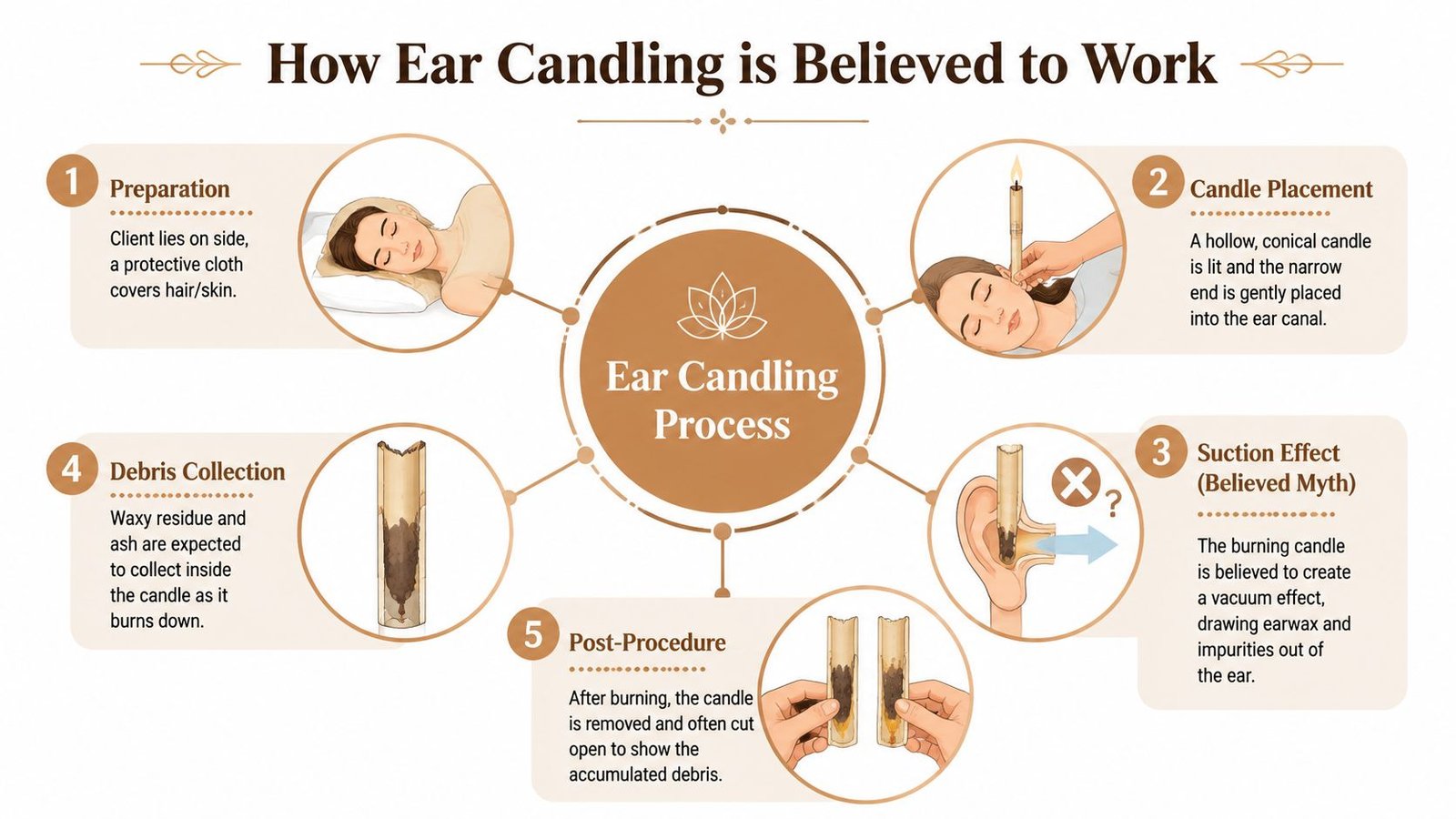
The usual setup is simple. A person lies on their side, a hollow cone made from cloth and wax is lit at the top, and the narrow end is placed near the ear opening while the flame burns downward. The idea is that the heat creates a gentle pull, almost like a tiny chimney.
That “chimney effect” is the core theory. Advocates say the rising warm air creates a vacuum that draws earwax and debris out of the ear canal. A basic analogy is a straw, where suction moves fluid upward, but ear candling is not a straw, and the ear canal isn't a sealed tube that behaves that way.
What the residue is supposed to mean
The candle is then cut open after the session, and the dark debris inside is often presented as evidence that something came out of the ear. That visual is powerful, and it's exactly why the practice stays persuasive to people who are trying it for the first time.
But the visible residue is part of the problem, not proof of success. The material in the candle can come from the candle itself, and the experience of seeing debris can feel convincing even when the mechanism doesn't hold up. That distinction matters because people are often judging the method by what they can see, not by what occurred in the ear.
The appearance of “extra material” isn't the same as removal from the ear canal.
The process is easy to describe, which is one reason it spreads so well in wellness settings. But ease of explanation doesn't make a claim true. Before anyone treats the ritual as ear hygiene, it's worth understanding that the theory is only a theory unless it can be shown to move cerumen safely and consistently.
The Clinical View on Ear Candling Efficacy

The clinical verdict is blunt. In a published study, a limited trial involving 8 ears found no removal of cerumen from the external auditory canal, and candle wax was deposited in some cases; the same paper reported that a survey of 122 otolaryngologists identified 21 ear injuries linked to ear candle use (PubMed). That combination matters because it shows failure at the intended job and harm in the same body of evidence.
Why the earwax claim does not hold up
If a method effectively removes wax, clinicians should be able to observe that effect in a controlled way. Here, the available evidence points the other direction. Ear candles did not show meaningful benefit in the ear canal, and the residue people notice is more consistent with candle debris than with cerumen removal, which is why the visual “proof” can be misleading.
The FDA later described ear candles as unapproved medical devices and warned consumers to avoid them (PubMed). That regulatory stance lines up with the broader medical consensus, which is that the practice lacks valid scientific evidence of benefit and shouldn't be treated as a legitimate ear-cleaning technique.
What people think they feel after a session
Some users report a sense of relief or lightness afterward. That doesn't automatically mean the candle cleared the ear canal. Warmth, a quiet environment, and focused attention can all change how a person perceives pressure or discomfort, even when no meaningful earwax removal has taken place.
The key point is simple. If a client wants help for wax buildup, the decision should be based on actual ear care, not on what the inside of a spent candle looks like afterward. That's the standard a clinical setting uses when separating a pleasant ritual from an effective intervention.
Documented Risks and Who Should Avoid This Practice
The main safety issue is not subtle. Safety data from medical and public-health sources show a hazard profile centered on thermal and mechanical injury, including burns to the pinna and external auditory canal, tympanic membrane perforation, temporary hearing loss, otitis externa, wax obstruction of the canal, and fire risk, even when used according to directions (FDA guidance summary). That's a serious list for a practice that is supposed to be gentle.
Documented risks
- Burns: Hot wax and an open flame can injure the ear, face, hair, or surrounding skin.
- Eardrum injury: The ear drum can be damaged by heat, wax, or improper placement.
- Wax blockage: Melted candle material can make an existing blockage worse.
- Temporary hearing loss: Swelling, blockage, or injury can reduce hearing.
- Otitis externa: Irritation and trauma can contribute to an inflamed ear canal.
- Fire hazard: Any flame near hair, cloth, and skin creates an avoidable risk.
The risk profile matters even more because the practice can look controlled from a distance while still failing in the details. A careful setup does not remove the fundamental problem that fire and softened wax are being placed close to a sensitive structure.
Who should avoid it
- Anyone with a perforated eardrum
- People with current ear infection
- Those with a history of ear surgery
- Anyone with ear tubes
- Clients with significant wax impaction
- People with allergies to candle ingredients
If there's pain, drainage, bleeding, or a history of eardrum problems, ear candling is the wrong direction. The safer move is assessment first, because those symptoms can mean something more than simple wax. In a practical wellness environment, informed consent means saying no to a ritual when the risk profile is clearly out of balance.
If you're unsure whether the issue is wax or irritation, don't guess at home. Get the ear examined.
What to Expect During a Professional Session

A responsible session starts before anything is lit. The provider should ask about ear pain, discharge, past infections, surgery, tubes, allergies, and whether you've had a recent change in hearing. That conversation isn't filler, it's the point where a safety-conscious therapist decides whether the session should happen at all.
If a provider proceeds, the environment should be calm, private, and organized. Hair and skin should be protected, the client should be positioned comfortably, and the flame should be managed with constant attention rather than treated as a passive step. Clean hands, clear explanation, and readiness to stop immediately if anything feels wrong are basic standards, not extras.
What a careful protocol looks like
A professional center should be able to describe exactly what it does and why. That includes discussing preparation, the role of a protective barrier, the order of the steps, and what signs would make the therapist pause or cancel the session. If the provider minimizes the risks or speaks as if the candle itself is harmless, that's a red flag.
This is also where the setting matters. A quiet room, a one-on-one approach, and a therapist who checks comfort throughout the session can make the experience feel more grounded, but comfort is not the same as effectiveness. A safe environment can reduce avoidable mishaps, yet it can't change the fact that the medical evidence does not support ear candling as earwax treatment.
For readers who still want to evaluate a provider, this professional ear candling service overview shows the kind of detail a responsible wellness center should communicate clearly. The most important question is whether the practitioner treats the ear as a delicate structure that deserves caution, or as a place to test a ritual.
Safer Evidence-Based Alternatives for Ear Care
If the goal is to deal with fullness or suspected wax, the better choice is not between candling and doing nothing. It's between candling and evidence-based earwax care (Cleveland Clinic overview). Safer options include watchful waiting, wax-softening drops, and clinician removal.
Earwax Management Options Compared
| Method | Safety Profile | Evidence of Efficacy | Who Performs It |
|---|---|---|---|
| Ear candling | Unsafe, with burn and injury risk | Not supported | Not recommended |
| Watchful waiting | Generally safe when symptoms are mild | Appropriate when wax may clear on its own | The individual, with guidance if needed |
| Wax-softening drops | Safer for many people when used correctly | Common evidence-based self-care option | The individual, sometimes with clinician advice |
| Clinician removal | Controlled and targeted | Established approach for troublesome wax | Trained clinician |
For many people, the first sensible move is patience plus a softening method, if there's no pain, drainage, or known eardrum problem. If symptoms continue, or if hearing feels significantly reduced, professional removal is the better route because the clinician can see what's there before taking action.
Best practical test: if the ear feels blocked and there's pain, discharge, or a surgery history, skip home experiments and get assessed.
A wellness-centered approach can still be careful and calming without leaning on an unsupported ritual. If you're exploring broader integrative care, the broader philosophy is outlined in this integrative health and wellness resource, but ear care should still follow evidence, not ceremony.
If you're dealing with ear fullness right now, choose the path that protects hearing first. Book a proper ear assessment, ask what's actually causing the blockage, and use a method that can be justified by both comfort and safety. For a calm, one-on-one discussion about your options, contact C&A Wellness Center and ask for guidance before you try anything with an open flame near your ear.