Your ear feels blocked, the plane is still taxiing, and you're doing that awkward swallow-and-pinch routine while everyone around you pretends not to notice. Or maybe the pressure showed up after a cold, during allergy season, or after a day of jaw clenching, and now every sound feels slightly muffled. Ear pressure relief works best when you match the method to the cause, because a stuffed-up tube needs a different nudge than a flight descent or a tight jaw.
Table of Contents
- Why Your Ears Feel Plugged in the First Place
- Quick Pressure Equalizers You Already Know
- Valsalva, Toynbee, and Frenzel Step by Step
- Supportive Relief With Warmth, Steam, and Decongestants
- Acupressure, Massage, and the Ear Candling Question
- Red Flags That Mean It's Time to See a Provider
- A Simple Routine You Can Save
Why Your Ears Feel Plugged in the First Place
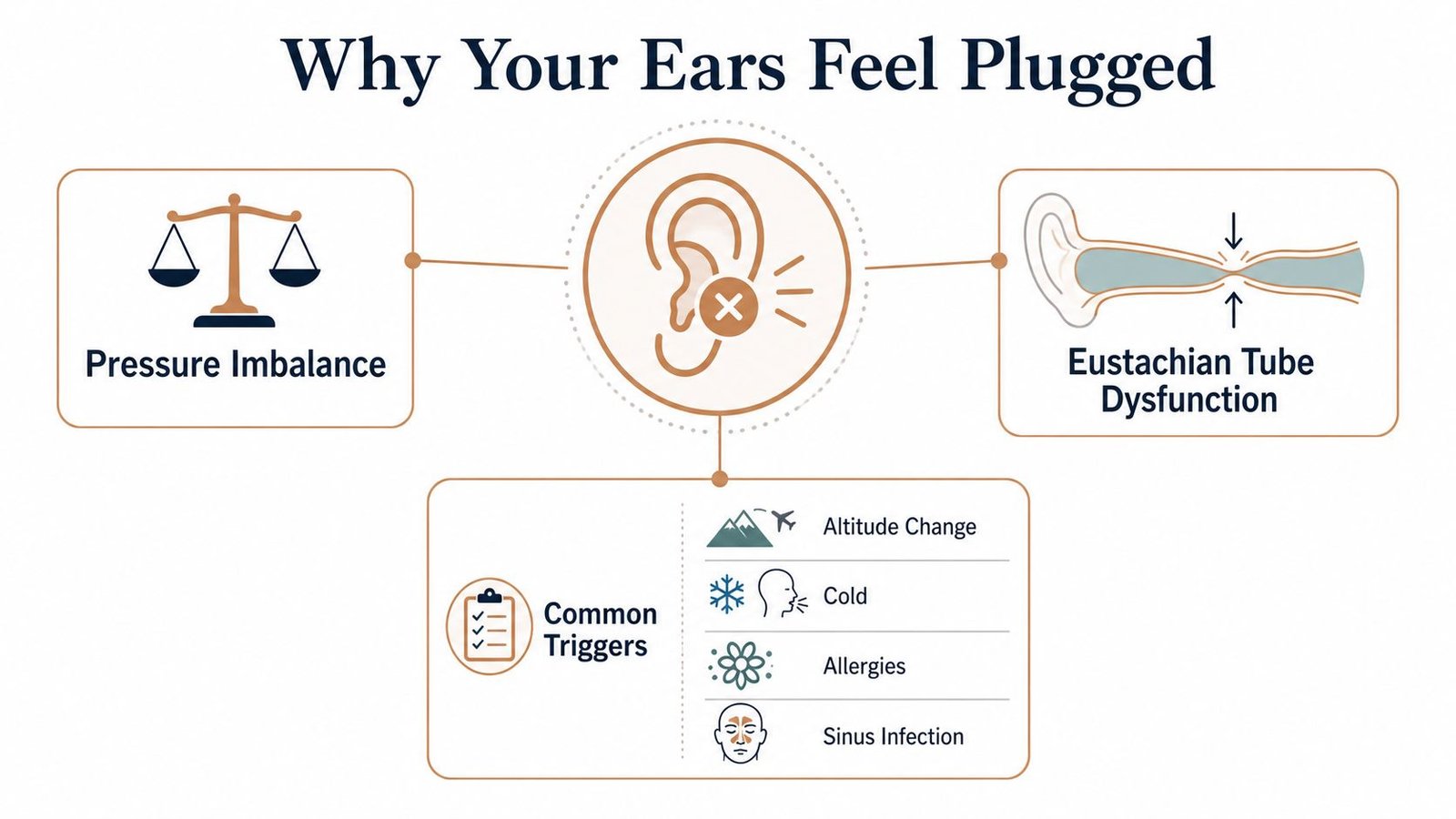
A plugged ear usually starts with a pressure mismatch between the outside world and the small air space behind the eardrum. The middle ear is supposed to stay equalized through the Eustachian tube, which opens to let air move in and out. When that tube is slow, swollen, or blocked, the ear can feel full, muted, or sore.
On a plane, that mismatch becomes obvious fast. A medical animation from St. Louis Children's Hospital notes that when the pressure difference reaches about 15 mmHg, the Eustachian tubes open with a popping sensation and air is released from the middle ears St. Louis Children's Hospital. That pop is the body's own equalization system doing its job.
The most common triggers are easy to recognize. Altitude change can force the issue during takeoff or descent. Congestion, sinus inflammation, allergies, and even jaw tension can make the tube less willing to open, so the ear pressure lingers instead of clearing.
Practical rule: if your ear pressure showed up during flying, a cold, or a bad allergy week, start by thinking about the tube, not the ear itself.
That distinction matters because it changes the fix. A clogged canal problem, a jaw problem, and a pressure-equalization problem don't respond to the same move.
Quick Pressure Equalizers You Already Know
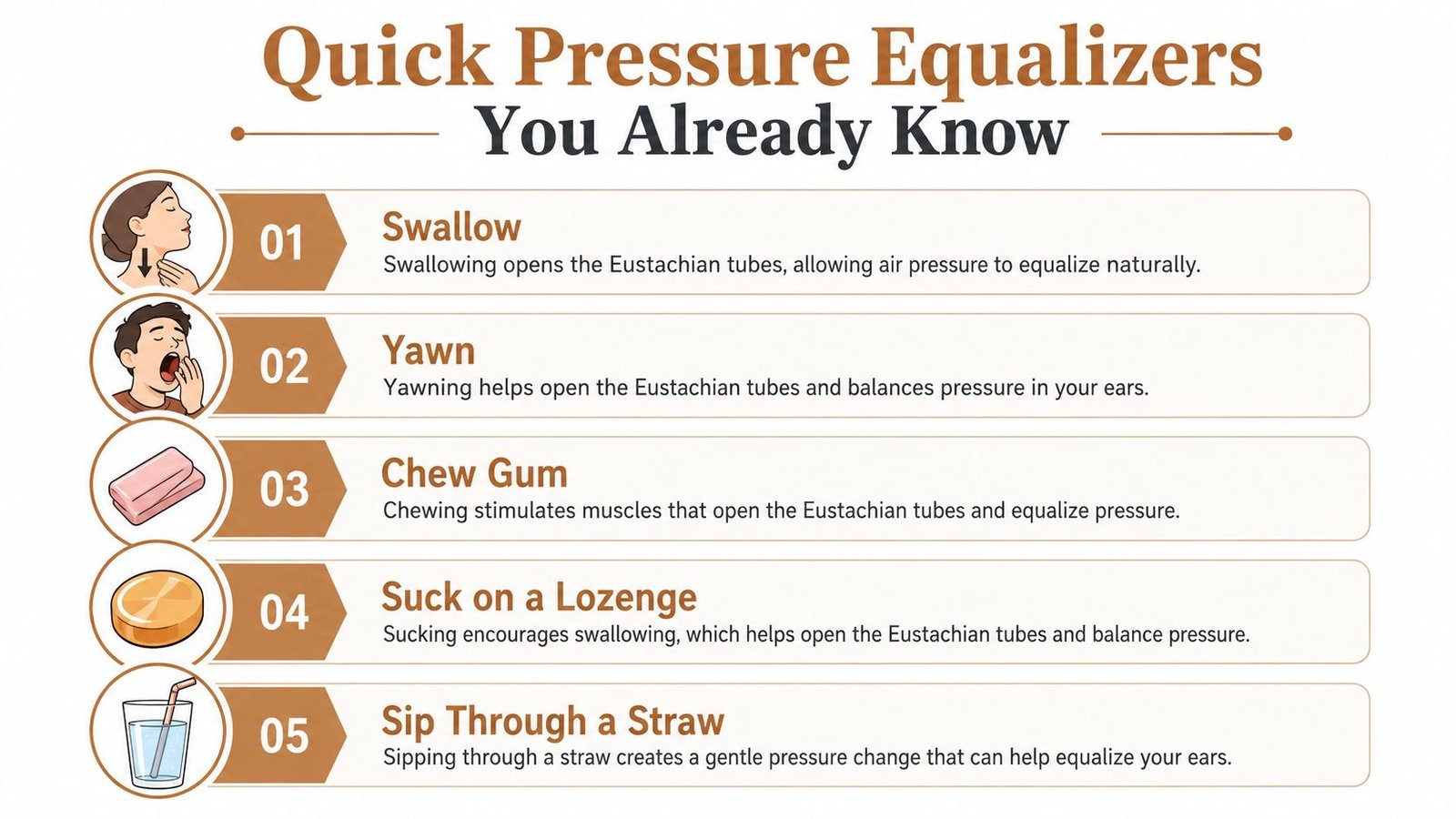
The easiest ear pressure relief methods are the ones your body already knows how to do. Swallowing is often the first try because it naturally opens the Eustachian tube. Yawning can do the same thing, even if you have to fake it for a moment.
A few small habits fit the same category. Chewing gum gives you repeated swallowing opportunities, which is why people reach for it during flights. A lozenge can help for the same reason, and sipping water through a straw encourages a swallow without requiring much effort.
Best low-effort choices by situation
- During a plane descent: chewing gum or swallowing works well because you can repeat it often.
- After a cold drink or dry throat: a dry swallow can be more useful than a wet one, since it doesn't add extra liquid to the mouth.
- When you need something subtle: yawning is the least effortful option and can be done without obvious preparation.
The small detail that people miss is that the swallow itself matters more than the water. In the source set, dry swallowing is reported as more effective than swallowing with water, and that lines up with the basic goal, which is to get the tube to open rather than to flood the throat.
If the first gentle effort works, stop there. You're trying to coax the tube open, not prove you can force it.
These everyday methods make the most sense for short-lived pressure, especially on a plane or after a brief change in altitude. If congestion is the main issue, they may help only a little, which is where the next level of support comes in.
Valsalva, Toynbee, and Frenzel Step by Step
The Valsalva maneuver is well-known, but it's also the one people tend to overdo. Sit or stand upright, close your mouth, pinch your nostrils shut, then gently exhale against the closed airway until you feel a pop or pressure change. Adult Eustachian tube guidance describes it as forced exhalation against a closed mouth and nose, with an emphasis on a slow, controlled exhale rather than forceful blowing NCBI Bookshelf.
The key is restraint. A harder blow isn't a better blow. The goal is to open the tube, not spike pressure in your head or make your ear hurt.
When to pick each maneuver
- Valsalva: best when you need an active equalization attempt and gentle swallowing hasn't done enough.
- Toynbee: pinch the nose and swallow. It's often a good next step when the first method stalls.
- Frenzel: used by divers and some frequent flyers, it relies on tongue and throat positioning rather than a forceful push.
A comparative study of 60 ears found Valsalva and Toynbee maneuvers were 51.7% effective, while the Ear Popper device was 43.3% effective, with no significant overall difference across methods St. Louis Children's Hospital. The useful lesson isn't that one method wins every time, it's that several gentle approaches can work, and none of them need to be aggressive.
The cleaner way to think about the sequence is simple. Start with swallowing or yawning, move to Toynbee if needed, and use Valsalva only as a controlled attempt. If pain, dizziness, or a sharp spike in pressure shows up, stop.
Supportive Relief With Warmth, Steam, and Decongestants
When the tube is swollen, equalization tricks often feel like they're bouncing off a wall. That's where supportive care can make the next attempt more likely to work. Warmth and moisture don't force the tube open, but they can help calm the irritation around it.
A warm compress over the ear for a short stretch can ease the uncomfortable fullness that comes with pressure. A steamy shower or a bowl of hot water with a towel over the head can do something similar for congestion. If the nose is blocked, saline rinses can help clear out mucus so the tube has less swelling to fight through.
Supportive methods at a glance
| Method | Best For | How to Use | Key Caution |
|---|---|---|---|
| Warm compress | Sore, full, or throbbing ears | Hold a warm cloth against the ear for a short, comfortable period | Keep it warm, not hot |
| Steam | Congestion-linked pressure | Use a steamy shower or bowl of hot water with a towel | Avoid burns and don't overdo the heat |
| Saline rinse | Stuffy nose, allergy flare, sinus congestion | Rinse the nasal passages gently | Use clean, appropriate saline only |
| Oral decongestant | Pressure tied to congestion, especially before flying | Use only as directed on the label | Not right for everyone |
| Nasal decongestant spray | Pre-flight congestion relief | Use 15 to 30 minutes before a flight rather than after landing | Limit use and follow label directions |
For flight-related pressure, the prevention window matters. The review in Middle-ear pain and trauma during air travel noted that oral pseudoephedrine reduced barotrauma symptoms more effectively than placebo in adults with prior ear pain, while oxymetazoline nasal spray was not more effective than placebo PMC review. That's a good reminder to match the tool to the actual problem, not just the label on the bottle.
Some people need to avoid decongestants altogether, especially if they have high blood pressure, pregnancy, or glaucoma. When in doubt, the label and your clinician's advice matter more than a guess. If you're also looking at broader relaxation support, a visit like infrared sauna guidance may be part of a calming routine, but it isn't a substitute for the right medical choice when the ear itself is the issue.
Acupressure, Massage, and the Ear Candling Question
Some readers want a technique that feels gentler than a pinch-and-blow. That's where acupressure, jaw massage, and neck relaxation come up again and again. These approaches are low-risk for many people, and they may help by easing tension around the jaw and ear, but the evidence is still mostly anecdotal Medical News Today overview.
The appeal is easy to understand. If your pressure seems tied to clenching, a tight jaw, or a long day at a screen, a few minutes of massage can feel restorative. The problem is that relaxation and proof are not the same thing, so these methods should be treated as supportive, not established ear pressure treatments.
Where massage fits best
- Jaw tension: gentle massage around the jaw hinge may feel calming when clenching is part of the picture.
- Neck tightness: soft massage along the upper neck can reduce the feeling of strain that sometimes travels with ear discomfort.
- Stress-related pressure: acupressure routines may help some people settle down enough to swallow or yawn more easily.
Ear candling needs a harder line. Major medical guidance warns against it, and there isn't reliable evidence that it removes wax. The risks include burns and perforated eardrums, which makes it a bad choice for pressure equalization. If you want to understand the safety concerns more fully, see ear candling safety considerations.
For people in Central New Jersey who want a quiet, one-on-one environment and are looking at complementary relaxation practices, C&A Wellness Center in Perth Amboy offers ear candling as a soothing experience. It should be treated as a relaxation ritual, not a medical fix for plugged ears.
Red Flags That Mean It's Time to See a Provider
Most ear pressure clears once the trigger passes, like a cabin change, a cold, or a bout of congestion. If the feeling lingers, the cause may be more specific than a temporary blockage. Persistent pressure can point to Eustachian tube dysfunction, middle-ear infection, sinus disease, TMJ disorder, or barotrauma Harvard Health.
A simple way to sort it is this. Short-lived, both-sided pressure after flying or congestion usually belongs in the home-care category. Persistent, painful, one-sided, or hearing-related pressure deserves a clinical exam. In practice, that means the gentle steps you use for a brief plugged feeling are a different tool from the care you need when the ear stops behaving like a pressure valve and starts acting like a problem that needs a closer look.
A provider visit is especially important if pressure comes with any of these patterns:
- Severe pain that does not ease with gentle measures.
- Sudden hearing loss or a clear change in hearing.
- Drainage from the ear.
- Fever or feeling generally ill.
- Dizziness or balance problems.
- One-sided pressure with jaw pain or chewing pain.
There is also a timing clue. A patient guide from the American Academy of Otolaryngology notes that mild ear pain or pressure without fever or hearing loss often does not require immediate medical attention, but pressure that lasts for several days should be checked. That matches the practical rule many clinicians use, home care first for the short version, evaluation for the stubborn version American Academy of Otolaryngology patient guide.
If you want a broader, calm-minded approach to self-care, the right clinic can help you sort out what is pressure, what is infection, and what is jaw tension. A good visit looks at the whole pattern, not just the ear, and an overview of our integrative health and wellness approach can show how supportive care fits into that kind of evaluation.
A Simple Routine You Can Save
Start with the least forceful move. Swallow, then yawn, then try Toynbee with a sip of water if the pressure is still there. If that doesn't work and you're sure the problem is pressure equalization, use a gentle Valsalva, not a hard blast.
If congestion is part of the picture, add support instead of brute force. Use a warm compress, a steamy shower, or a saline rinse to help the tube open more easily. If you already know a decongestant is appropriate for you, timing it before a flight matters more than trying to rescue the ear after the cabin pressure has already changed.
Keep this short checklist in mind:
- Try home equalizers first when the pressure is brief and linked to flying, a cold, or allergies.
- Stop if pain gets sharper, or if you feel dizzy.
- Skip decongestants if your clinician has told you not to use them.
- Book a visit if the pressure is one-sided, severe, or not clearing after several days.
For adults in Perth Amboy and nearby Middlesex County who like having a calm, private wellness setting for supportive care, C&A Wellness Center offers one-on-one services that include ear candling, colon hydrotherapy, infrared sauna, and ionic foot detox. If you want a local place that treats relaxation and self-care as a deliberate routine, visit C&A Wellness Center and see whether its private, guided setting fits the way you like to care for yourself.