
Most practitioners start with 3 to 6 sessions over a few weeks, then shift to maintenance every 1 to 3 months. There isn’t a universal frequency, because the right rhythm depends on your symptoms, your goals, and how your body responds.
How often should you do colonics if you’re treating a digestive issue, and how often should you do them if you’re trying to maintain a wellness routine? That’s where the conversation gets more useful than a generic calendar. A thoughtful schedule separates short-term support from long-term upkeep, and it also respects the fact that colon hydrotherapy isn’t the same for everyone.
Table of Contents
- Understanding Colon Hydrotherapy Frequency Basics
- Recommended Schedules Based on Your Wellness Goals
- What the Medical Evidence Says About Safety and Frequency
- Signs Your Body May Benefit from Another Session
- Who Should Avoid Colonics or Seek Medical Clearance First
- Preparing for and Recovering from Each Session
- What to Expect at C&A Wellness Center in Perth Amboy
Understanding Colon Hydrotherapy Frequency Basics
The short answer is simple, there’s no universally agreed-upon frequency for colon hydrotherapy. Practitioner guidance commonly places a person’s schedule somewhere between an initial series of 3 to 6 sessions over a few weeks and a later rhythm of monthly or quarterly maintenance https://regenerated.health/colon-hydrotherapy-guide/.
Why the first sessions are usually closer together
Early sessions are often treated like a starter phase, not a forever plan. Guidance from one practitioner-based source describes an initial pattern of 2 to 3 sessions over 7 to 10 days for first-timers, with other protocols suggesting 3 to 6 weekly sessions for ongoing constipation concerns. That staged approach reflects a practical truth, the body may respond differently after the first appointment than after the second or third.
Practical rule: if you’re new, treat the first few sessions as information-gathering, not proof that you need constant appointments.
A maintenance rhythm works differently. For generally healthy adults, wellness guides commonly describe upkeep as once every 1 to 3 months or 3 to 4 times per year, while some medical-advice guidance says irrigations are often limited to no more than once every 4 to 6 weeks https://ubiehealth.com/doctors-note/colon-hydrotherapy-risks-freq-irrigation-limits-3452q2. The exact timing changes with tolerance, goals, and symptom patterns.
The real scheduling question
The better question isn’t “How often should everyone do colonics?” It’s “What am I trying to change, and how is my body reacting?” A person working on sluggish digestion may need a short series first, while someone using colon hydrotherapy as a wellness routine may only want spaced check-ins. The literature supports a finite series followed by spaced follow-up, not a daily or indefinite weekly habit.
A useful baseline is this, routine upkeep usually lands somewhere around 4 to 12 sessions per year, with many recommendations clustering around 4 sessions annually for general wellness and 6 to 10 sessions annually for more frequent maintenance https://ubiehealth.com/doctors-note/colon-hydrotherapy-risks-freq-irrigation-limits-3452q2. That’s a starting framework, not a rulebook.
Recommended Schedules Based on Your Wellness Goals
Different goals call for different pacing. Someone coming in for a reset, someone managing constipation, and someone maintaining general wellness aren’t looking for the same thing, so they shouldn’t get the same schedule. The most helpful plans are the ones that match purpose to frequency.
Compare your path before you book
| Goal | Recommended Frequency | Typical Duration |
|---|---|---|
| Initial reset or starter series | 2 to 3 sessions over 7 to 10 days, or a short series over a few weeks | Short-term, then reassess |
| Constipation or chronic digestive support | 3 to 6 weekly sessions, sometimes beginning with 3 sessions over 7 to 10 days | Several weeks, then taper |
| Ongoing maintenance | Once every 1 to 3 months, or 3 to 4 times per year for lighter upkeep | Long-term, spaced out |
For IBS-related questions, a separate clinic resource may help frame the conversation in more condition-specific terms, including how frequency is discussed in relation to digestive comfort. See the discussion at this IBS-focused colon hydrotherapy resource.
Initial reset and starter plans
A first-time client usually benefits more from a short series than from a one-off appointment. One guideline recommends 2 to 3 sessions over 7 to 10 days for new clients, while another practitioner-based source allows for a more extended starter plan of 6 to 8 sessions spaced 4 to 14 days apart before moving to less frequent upkeep. That kind of range shows how much the body’s response matters.
Therapeutic support for constipation
When constipation is the main issue, frequency usually increases at the start. Practitioner guidance commonly points to 3 to 6 weekly sessions for chronic constipation, and some sources place the first phase at 3 sessions over 7 to 10 days before tapering. The aim is to create momentum, then stop forcing the schedule once things stabilize.
Maintenance for generally healthy adults
For ongoing wellness, the cadence gets much gentler. Sources commonly describe maintenance as every 4 to 8 weeks, every 2 to 3 months, or seasonally, which lines up with the broader monthly to quarterly pattern https://ubiehealth.com/doctors-note/colon-hydrotherapy-risks-freq-irrigation-limits-3452q2. If you’re using colonics as a wellness tool rather than a treatment plan, that slower rhythm is usually the more realistic fit.
What the Medical Evidence Says About Safety and Frequency
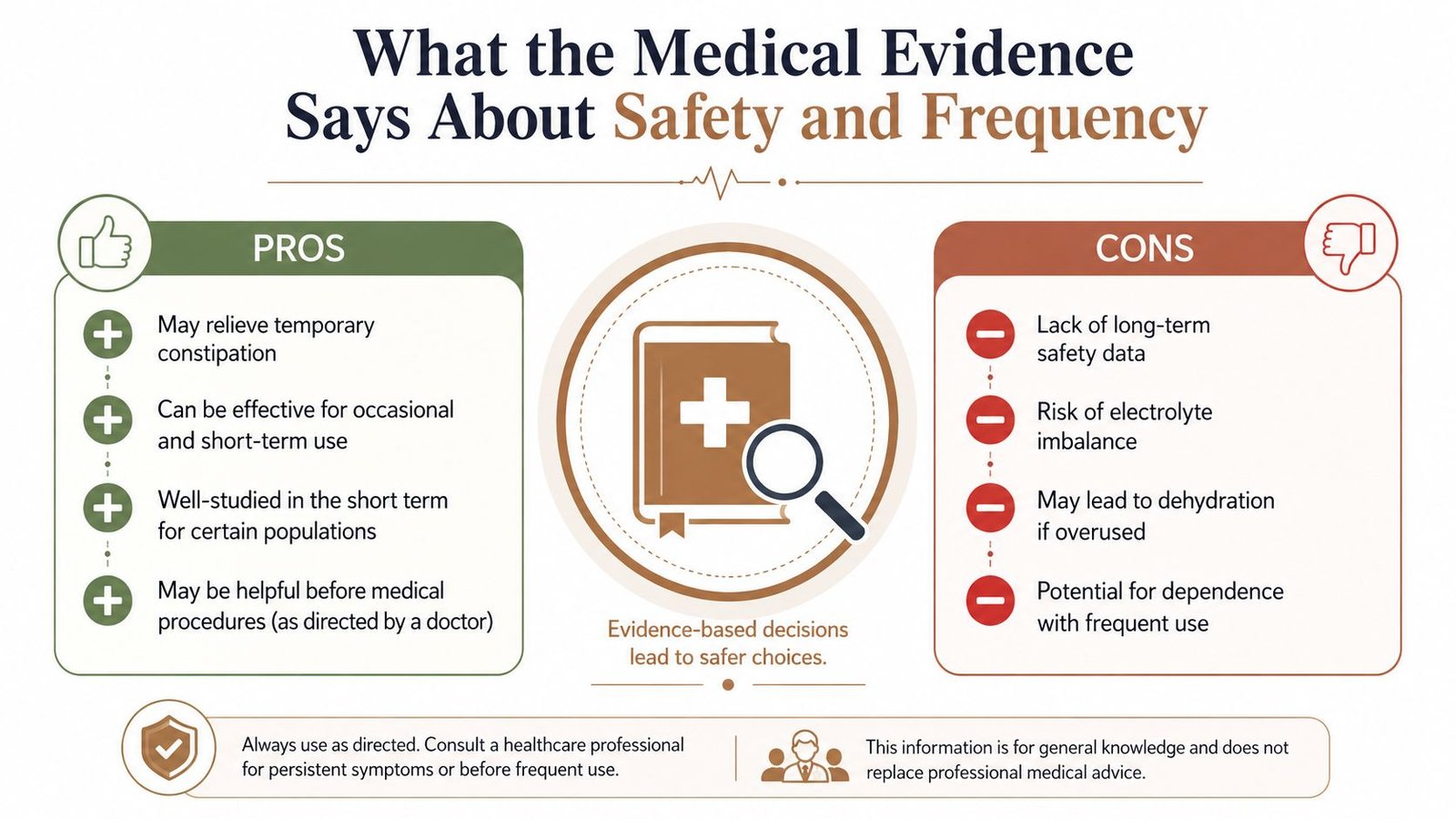
Neutral medical guidance does not treat colon cleansing as a routine health practice. Mayo Clinic notes that colon cleansing is generally not proven to provide lasting health benefits and may carry risks such as dehydration, electrolyte imbalance, and bowel injury https://www.mayoclinic.org/healthy-lifestyle/consumer-health/expert-answers/colon-cleansing/faq-20058435.
Where the evidence and the wellness world diverge
That gap matters because wellness advice often frames colonics as if they belong in a regular maintenance routine. Medical guidance is more cautious, especially once the discussion shifts from short-term relief to repeated use. The same Mayo Clinic guidance makes that point clear, so frequency should be treated as a question of need, tolerance, and risk rather than habit.
Colon hydrotherapy may be chosen as a wellness service, but frequency should stay tied to tolerance, goals, and screening.
A responsible practitioner treats frequency as a clinical decision, not a sales target. If a client keeps requesting more sessions without a clear reason, the better response is to pause and review whether the issue is constipation, stress, diet, or a medical problem that needs a different kind of care.
Why “more often” isn’t automatically better
Frequent sessions can work against the body if someone is already sensitive or depleted. The risk profile changes when irrigation is repeated too close together, especially when hydration is poor or there is a health issue that makes colon cleansing unsafe. That is why a short series followed by reassessment is the safer model, instead of an open-ended weekly routine.
For local readers considering a supervised appointment, a screened, one-on-one setting such as C&A Wellness Center’s New Jersey colon hydrotherapy service is the kind of environment where frequency can be discussed alongside comfort, goals, and health history.
Signs Your Body May Benefit from Another Session
Calendars matter less when your body is clearly giving you feedback. If your digestion starts to feel sluggish again, that can be a more useful cue than waiting for a preset date. The key is learning the difference between ordinary day-to-day variation and a pattern that keeps returning.
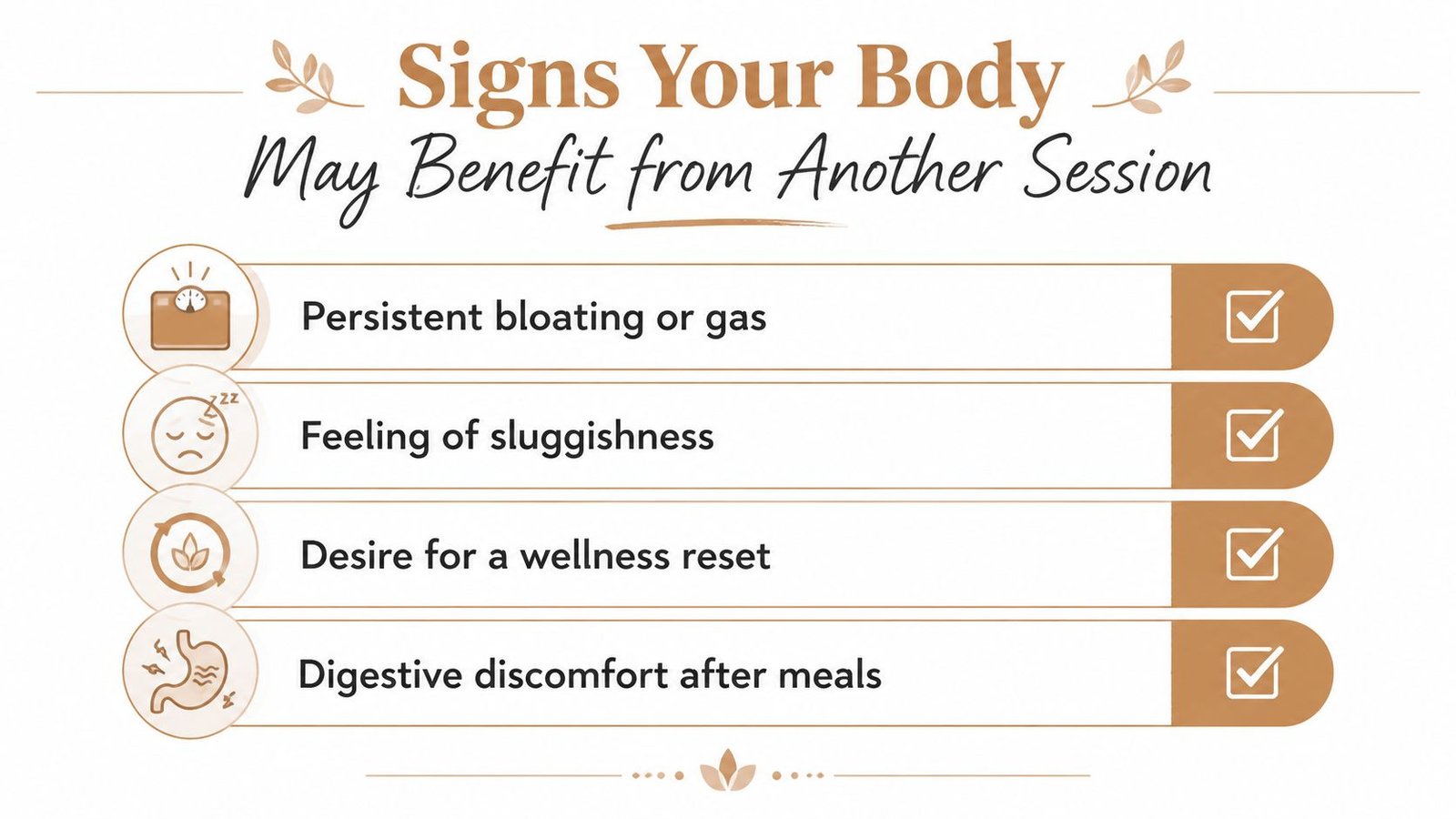
Common signals people notice
- Persistent bloating or gas. If pressure and fullness keep coming back, many clients use that as a sign to reassess timing.
- A sluggish, heavy feeling. Some people describe this as digestion feeling “stuck” or slow.
- Digestive discomfort after meals. Repeated discomfort after eating can point to a return of the pattern you were trying to improve.
- A wellness reset feels overdue. If your routine, stress, and eating habits have drifted, another session may fit better than waiting.
Those signs don’t automatically mean you need frequent colonics. They do mean your current rhythm may no longer match your body’s needs. A session can make sense when the goal is comfort, clarity, and a return to a steadier routine.
What to watch between appointments
Not every off day means it’s time to rebook. A single heavy meal, travel, or a few stressful nights can change digestion temporarily. Look for a repeated pattern, especially if the same symptoms return after several days or weeks rather than clearing on their own.
Practical rule: if the same digestive complaint keeps showing up after your usual spacing, the schedule probably needs adjustment.
Some clients also notice changes in energy, concentration, or how “clean” they feel overall, but those observations are personal and shouldn’t be treated as medical proof. The more grounded approach is to pair those feelings with what’s happening in the bathroom, after meals, and across the week. That gives you a clearer sense of whether another session is useful.
Who Should Avoid Colonics or Seek Medical Clearance First
Colonics aren’t for everyone, and that’s not a minor detail. A responsible therapist screens for conditions that make colon hydrotherapy unsafe, or at least unwise without medical approval. That screening matters more than any routine schedule.
Red flags that change the decision
People with inflammatory bowel disease, recent colon surgery, severe hemorrhoids, pregnancy, or certain heart or kidney conditions should not assume colonics are automatically appropriate. Those situations can change the risk profile enough that a doctor’s input comes first. Medications that affect fluid balance or bowel function also deserve a closer look.
The safest practitioners don’t skip the intake conversation. They ask about bowel history, surgeries, bleeding, pain, and current health concerns before booking a session. If something sounds uncertain, they pause and refer the client out instead of pushing ahead.
Why clearance matters
The reason for caution is straightforward. Colon cleansing can affect fluid balance and strain tissues that are already irritated or vulnerable. If you’re dealing with a complex condition, the question isn’t how often to do colonics, it’s whether colonics belong in your plan at all.
- Ask first if you’re pregnant or recently had surgery.
- Get medical guidance if you have a heart, kidney, or inflammatory bowel condition.
- Treat bleeding, severe pain, or unusual symptoms as a stop sign, not a scheduling issue.
A solid consultation should leave you clearer, not more pressured. If a provider can’t explain why a frequency recommendation fits your situation, keep asking until it does.
Preparing for and Recovering from Each Session
Preparation and aftercare shape how well a session fits into your routine. If you arrive dehydrated, rushed, or overly full, the experience is usually less comfortable. If you recover well afterward, the spacing between visits tends to feel more manageable.
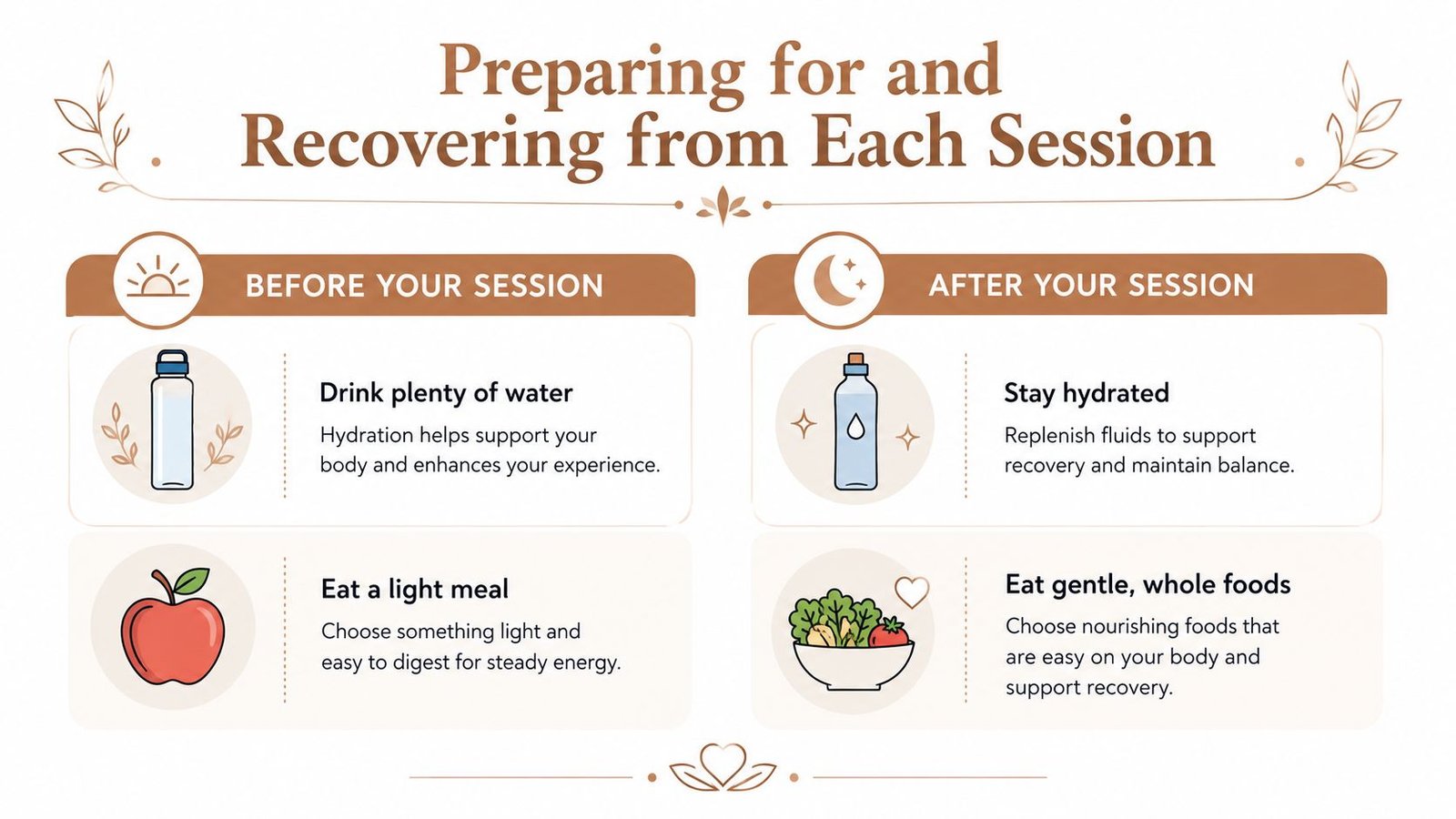
Before your session
Drink water steadily in the day or two before your appointment. Eat a light meal rather than showing up overly stuffed, and keep the meal simple enough that your body isn’t working hard to digest it during the session. If you’re planning around exercise or sauna use, don’t stack too many intense wellness activities right on top of each other.
After your session
Hydration still matters after you leave. Choose gentle, whole foods and give your body a calmer window to settle before you decide on the next appointment. That’s one reason a short series can work better when it’s paired with good aftercare, rather than treated like a stand-alone fix.
For a more detailed food-based recovery approach, see what to eat after a colonic.
The strongest schedule is the one your body can recover from. If your aftercare is sloppy, the interval between sessions may need to be longer. If your recovery feels smooth and your symptoms ease, a slower maintenance rhythm may be enough.
What to Expect at C&A Wellness Center in Perth Amboy
At C&A Wellness Center, appointments are private and one-on-one, so frequency gets discussed in the room rather than handed to you as a rigid package. The center is at 416 Washington St. in Perth Amboy, and it’s open daily from 8 AM to 3 PM for clients across Edison, Woodbridge, Sayreville, and surrounding Middlesex County communities.
The visit usually starts with a conversation about your goals, symptoms, comfort level, and whether you want a single session or a short series. An I-ACT certified therapist guides the appointment, explains the process clearly, and helps you decide whether the next session should be soon, spaced out, or held until you see how your body responds. That kind of consultation is the most honest way to answer how often you should do colonics for your own situation.
If you’re new, starting with one session first is a sensible way to assess comfort and response before committing to a schedule.
If you want a private, therapist-guided setting for colon hydrotherapy in Perth Amboy, C&A Wellness Center offers one-on-one appointments, clear intake, and practical guidance on session spacing. Visit the center’s site to talk through your goals, compare a starter series with maintenance care, and decide what rhythm fits your body best.